
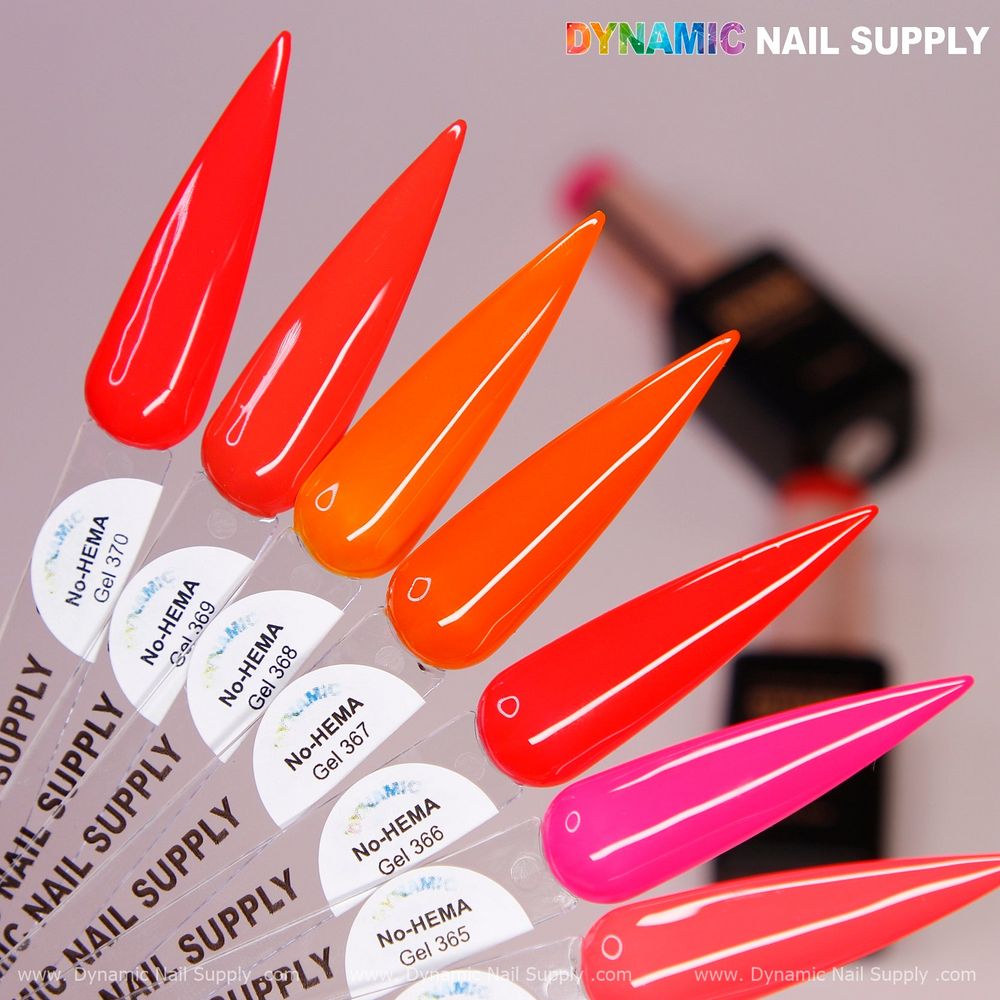
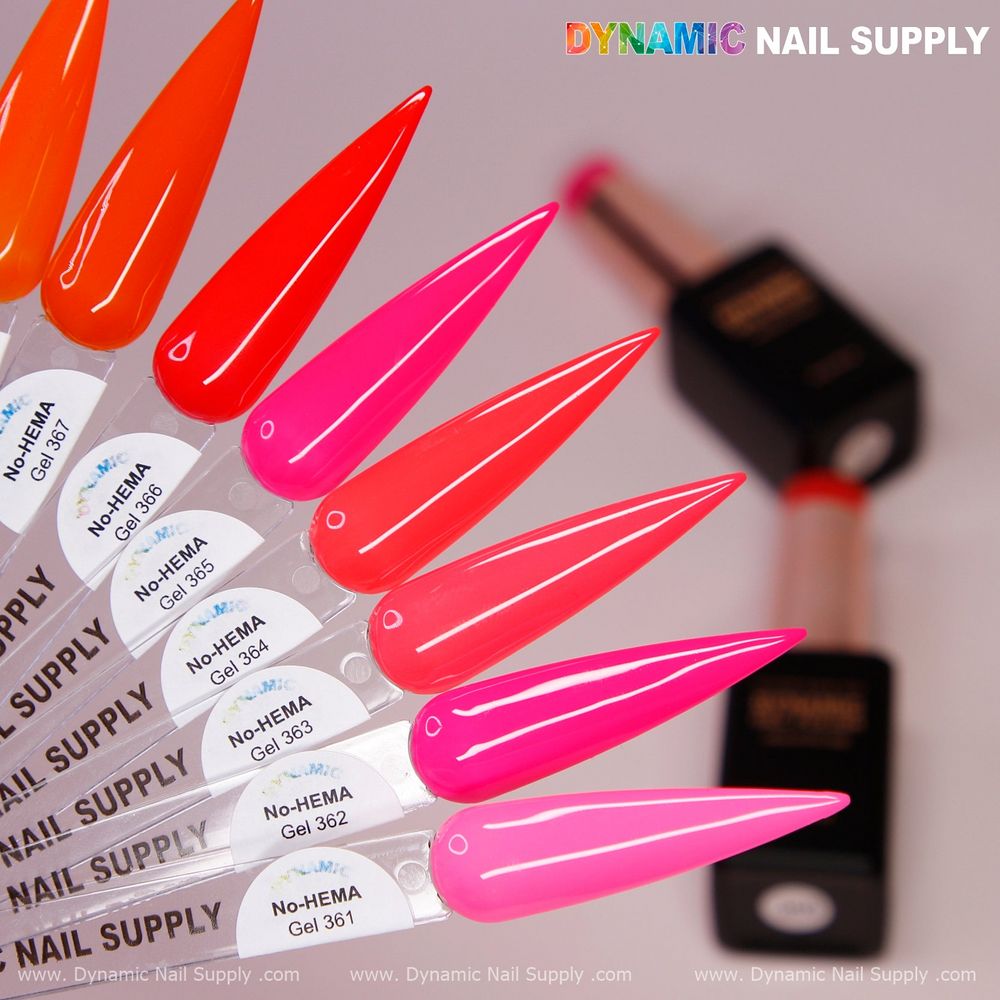
361 370 Pretty Pink Red Collection is a ten-shade, high-gloss cream gel polish set built for saturated tropical ombrés on stiletto or short nails.
Who is this service for and what makes the palette work?
This tangerine to fuchsia ombré workflow is written for experienced techs who need repeatable speed and precision. The collection moves from warm orange-reds through coral to vivid hot and bubblegum pinks in opaque, mirror-gloss creams—ideal when you want an energetic, neon-leaning gradient that photographs cleanly on long stiletto swatches and reads bold on short nails as well.
How do you set up your station for a fast, consistent blend?
Arrange three role colors before you start: an anchor tangerine-red for the tip, a coral red for the mid-transition, and a fuchsia/pink for the cuticle zone. Pull No-HEMA Gel 364–367 (or adjacent options from 361–370) so you have two neighbouring tones for feathering. Use a medium-dense gel brush for placement and a fine, soft fan or flat synthetic brush for blending; keep a small glass dish with 91% nail cleanser and lint-free wipes on hand to control viscosity at the edge. If you stock by SKU, these shades are $8 each (prices may change).
What base and cure sequence produces the most consistent adhesion and sheen?
Start with a thin, dehumidified base film: push back cuticles, buff to 180–240 grit where needed, remove dust, and apply a thin dehydrator/primer compatible with HEMA-free systems. Lay a thin builder-base or soak-off base that levels slightly—this collection’s cream pigments are high-viscosity, so a thin, tack-free base layer helps you keep color layers thin and avoid pooling at the cuticle. Cure base per your lamp spec, then proceed to color layers cured 60–120s under your UV/LED lamp.
Use Pretty Pink Red Collection to select the exact orange, coral and fuchsia tones you need for a consistent salon ombré.
How do you build a smooth tangerine to fuchsia ombré step-by-step?
- Block placement, one nail at a time: Paint three thin vertical blocks—tip (tangerine/red), center (coral red), cuticle (fuchsia pink). Keep films thin; heavy application makes blending harder.
- Edge feathering: Before curing, use a clean flat synthetic brush dampened with a little cleanser to pull each block’s edge toward the next color in short, light strokes until the boundary softens. Work quickly: these HEMA-free creams level differently than HEMA-based gels, so you need brisk, confident strokes.
- Pulse cure: Do a short pulse cure (10–15s) to tack the blend slightly, then refine any visible streaks with another feathering pass and finish a full cure (60–120s).
- Second-pass saturation: If the center still shows banding, apply a micro-film of the mid-tone along the seam and repeat feathering/pulse cure. Thin layering keeps the ombré soft while preserving the collection’s opaque, glossy finish.
- Edge cleanup: After full cure, use a fine brush and remover to neaten cuticles and sidewalls, then apply a glossy no-wipe topcoat and final cure.
For short nails, compress the zones proportionally: reduce each vertical block width and focus feathering in the middle third of the nail so the gradient reads even at smaller scale.
Use the adjacent shades from the set to create subtle midpoints rather than thinning with alcohol—this preserves the mirror-gloss cream appearance the collection shows in swatches.
For techniques integrating extensions, build the color on the extension free edge first to control bleed, then move to the natural nail junction and feather as above; thin base layers at the junction maintain long-term adhesion.
Special attention: How should you use No-HEMA Gel 361?
No-HEMA Gel 361 appears on the warm end of the set as a neon-leaning coral red; use it as your primary tangerine-to-coral anchor when you want a bright start to the gradient. It reads high-saturation under camera lights and pairs cleanly with fuchsia 369–370 for contrast. When you need an intense tip, place 361 at the free edge and feather inward with 365–368 to avoid hard lines.
How do you protect the finish and advise clients on wear?
- Seal with a high-gloss no-wipe topcoat cured to full lamp specs; the collection’s creams keep a mirror sheen when properly sealed.
- Recommend oil and gentle filing habits to clients—no abrasive tools against the gloss.
- Avoid excessive soaking in hot water immediately after service to reduce edge lifting for the first 24 hours.
What safety and handling points matter for HEMA-free gels?
Use standard salon PPE: minimize skin contact, use good ventilation, and avoid direct UV exposure. HEMA-free formulations reduce the chance of HEMA-linked sensitivities, but keep bottle caps closed when not in use and store upright at room temperature.
Mini glossary
- Pulse cure — short cure to tack the layer while allowing refinement.
- Feathering — brushing between color blocks to soften the seam.
- Micro-film — an ultra-thin color layer used to adjust tone without adding bulk.
Mini FAQ
- Can you do this on short nails? Yes—compress the zones and concentrate feathering in the center third.
- Which shades make the cleanest midpoint? Use an adjacent coral red from the 361–370 set as the midtone to avoid banding.
- How long to cure? Follow your lamp’s spec; expect 60–120s for full cure with these creams.
